Largest Contentful Paint
LoadingHow long until the main thing on the screen, usually the top image or headline, has appeared. The target is 2.5 seconds, and oversized hero images and slow hosting are the usual causes of failure.

Speed Optimization
Website speed optimization starts with why your site is slow, what Google measures, and what it takes to pass, tested on the kind of phone your customers use.
Your own site probably feels quick to you, because you open it on office wifi, on a recent computer, with most of it already stored by your browser. A customer in Malvern, however, opens it for the first time on a three-year-old phone on mobile data. Those are different experiences, and Google measures the second one.
Speed affects two things at once. First, visitors leave pages that take too long, so you lose the inquiry. Second, Google uses real loading data from Chrome users as a ranking signal, so a slow site is also shown less. That makes website speed optimization one of the few jobs that helps both.
Search demand
In Canadian suggestion data, people describe the symptom first and only later learn the vocabulary.
PageSpeed Insights shows a score out of 100 at the top, and it is tempting to chase it. However, that number comes from a simulated test. What Google uses for ranking is the section headed “real users”, which reports whether actual visitors passed the three Core Web Vitals. As a result, a site can score 60 and pass, or score 95 and fail. So our website speed optimization works to the real-user data and treats the score as a rough guide.
Where the time goes
In nearly every audit, most of the delay comes from two or three of these.
A photo straight from a phone camera is several megabytes and thousands of pixels wide, shown in a space a few hundred pixels across. Resizing and converting to a modern format often cuts page weight by more than half.
Visual builders make editing easy, but they add a great deal of code to every page to do it. For instance, it is common to find thirty or more scripts on a builder-made home page.
Chat widgets, pop-ups, social feeds, several analytics tags and embedded maps each add their own downloads. Some are worth it, while most were added once and forgotten.
On an overloaded shared server the first response alone can take over a second, and nothing done to the page can make up for that.
Without caching, the server rebuilds every page from scratch for every visitor. With it, by contrast, most visitors receive a ready-made copy almost instantly.
What Google measures
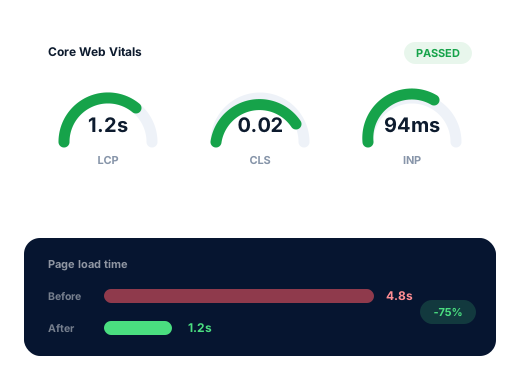
These come from real visits by Chrome users over the previous 28 days, and Google explains each one in its Core Web Vitals documentation. A page passes when three quarters of visits meet all three targets.
How long until the main thing on the screen, usually the top image or headline, has appeared. The target is 2.5 seconds, and oversized hero images and slow hosting are the usual causes of failure.
How long the page takes to react when someone taps a button or a menu. The target is 200 milliseconds, so heavy JavaScript from chat widgets, sliders and tracking tags is normally to blame when it fails.
How much the page jumps around while loading, the effect that makes you tap the wrong link. The target is under 0.1. In most cases, images without set dimensions and late-loading banners cause it.
The work
We record real-user Core Web Vitals and lab results for your key pages before changing anything, so the improvement can be shown.
Every image resized to the space it fills, compressed, converted to WebP or AVIF where supported, and then lazy-loaded below the first screen.
Unused plugins removed, non-essential scripts delayed until after the page is usable, and stylesheets trimmed to what the page needs.
Page caching configured for your host, as well as a content delivery network in front where it helps.
If the server is the limit, we show you the evidence and the options, but moving host remains your decision.
We re-test lab results straight away. Real-user data takes about a month to update, so we report it when it does.
Done carefully
These are the limits we work inside by default, whether or not anyone asks.
A faster site will not rescue weak content, and a perfect score is not required to rank.
Speed is one ranking signal among many, and its main benefit is that fewer visitors give up. That is why we will tell you when a site is fast enough and further work would be money better spent on content or your Google profile.
Ask us about your business
How we work
Four steps, in order. You always know which one we are on and what it is for.
We check your site, your Google Business Profile and where you rank from several points across Scarborough, then show you the gaps.
We choose the searches worth winning in your neighbourhoods and assign each one to a single page, so no two pages compete.
Profile work, technical fixes, content and citations, done in order of impact so the biggest gains land first.
A monthly report on rankings, traffic, calls and forms, with next month’s plan written in plain English.
Questions
Search for PageSpeed Insights, enter your address and choose the mobile tab. Then look first at the real-user section at the top. If it says there is not enough data, your site does not get enough Chrome traffic yet, so the lab results below are the best guide.
The main content should appear within 2.5 seconds on a phone, the page should respond to taps within 200 milliseconds, and nothing should jump around as it loads.
It can help where you are close to competitors, since Google uses page experience as a signal. Even so, the more reliable gain is in visitors who stay long enough to contact you.
One to two weeks for most small sites. Google’s real-user figures are a 28-day average, so the official result appears about a month later.
Not always. We measure what it costs in load time and show you. Some sites pass with the builder kept, while others cannot, and then it is your call.
We quote speed work as a one-time job in Canadian dollars after an audit, because the amount of work varies widely between sites.
Works best alongside
Local SEO, Google Maps, Google Ads, web design, maintenance and speed. Each one also makes the others more effective.
See all servicesFurther reading
Practical guides on the same subject, written for Scarborough business owners.
Each one is a separate piece of work. Most clients start with one.
Every trade searches differently, so each page is researched on its own.
A free audit shows where you rank across the neighbourhoods you serve, who is ahead of you, and what to fix first.
Get your free SEO audit